
In beginning, Elohim . . .
The first name God gives Himself can be found in Genesis 1:1
In beginning, Elohim created the heavens and the earth
Elohim appears more than 2,000 times in the Bible, more than 30 times in the first chapter of Genesis alone. Elohim is the Creator, and He deemed creation very good. He delighted in His creation. He delights in us.
From the very first verse, we see that Elohim created time, “in beginning;” space, “the heavens;” and matter, “the earth.” There was no “before” before the beginning. That’s when time started. There was no space, no place to put anything, before the beginning. And there was no matter, nothing, literally no thing before, “In beginning.” It all began with Elohim.
Elohim also speaks of His triune nature. The -im ending denotes a plural noun, yet the corresponding verb is singular. Elohim is three in one, and we see all three persons of the Trinity at Creation.
In verse 2, His Spirit hovered over the surface of the waters. The verb hovered, רָחַף, pronounced rahap, connotes vibrated or shook with great intensity. This video is a great visual of what that process might have been like. (On a much grander scale!)
The Father spoke the universe into existence. He created light with one word,אוֹר. “Owr.” Let there be light. One little three letter command. Bam! Light.
In Colossians, we see that all things were created by Jesus, the image of the invisible God and the firstborn of Creation.
He is the image of the invisible God, the firstborn of all creation: for by Him all things were created, both in the heavens and on earth, visible and invisible, whether thrones, or dominions, or rulers, or authorities—all things have been created through Him and for Him. He is before all things, and in Him all things hold together. – Colossians 1:15-17
How has knowing God as Elohim impacted you?
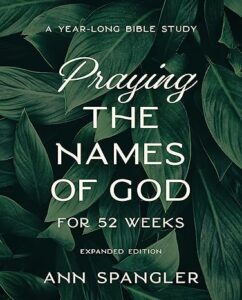 Join us as we pray through the Names of God this year using Ann Spangler’s book as our guide.




One of Chris’ friends from school here. Very interesting post! It’s really great to see people talking about the appearance of the Trinity and Christ in the Old Testament.
While Elohim can be translated as God, it is also important to note that it can also be translated as gods. We tend to apply our modern theology backward to the early Hebrews, especially when it comes to monotheism. Elohim is frequently used to refer to both angels (fallen and unfallen) and saints. They of course would not say that these ‘gods’ are the most high God, but rather just a word for divine beings. The usage of Elohim to refer to angels actually increased during the second temple period, which refutes the claims that Judaism evolved out of some sort of pantheism. I think a lot of modern Christians have a sort of squeamishness about the language of ‘gods’ to refer to the holy ones of God, but the ancient Israelites certainly did not. We truly live in a crowded spiritual world! Looking forward to posts on ‘The Angel of the Lord’ and ‘The Heavenly Man’.
Thank you, Ben! I’m sure you’ve read Michael Heiser’s The Unseen Realm – his take on the Divine Council, the B’nai ha Elohim. Fascinating!
I’m looking forward to your insights! Christophanies and theophanies are my favorite.