For the Homeschool Grammar Nerds
This is a follow up post to Why I Write.
What’s the longest sentence in the Bible?
That’s kind of a trick question. The longest sentence in the original Greek and the longest sentence in the modern English translations are in the same chapter, but they’re different verses. In Greek, Ephesians 1:3-14 is one sentence.
One sentence!
Come on, Paul!
I love it, though. I can imagine Paul being so overwhelmed with the awesomeness of God that he just keeps writing. He did this – and this – and we have all this because of it.
And then we come to Ephesians 1:15-21. These seven verses are just one sentence in English. 175 words! For grins, I ran it through a grammar checker. It called my sentence length into question. It recommends keeping your sentence length to 11-18 words.
Ya think?
Back in our homeschooling days when we were diagramming sentences, this one popped out at me during my Bible study.
No, I didn’t make the kids diagram it.
But I did think about it. Mwahaha.
If you’re a homeschool mom or a grammar nerd, maybe you’ll want to give it a go.
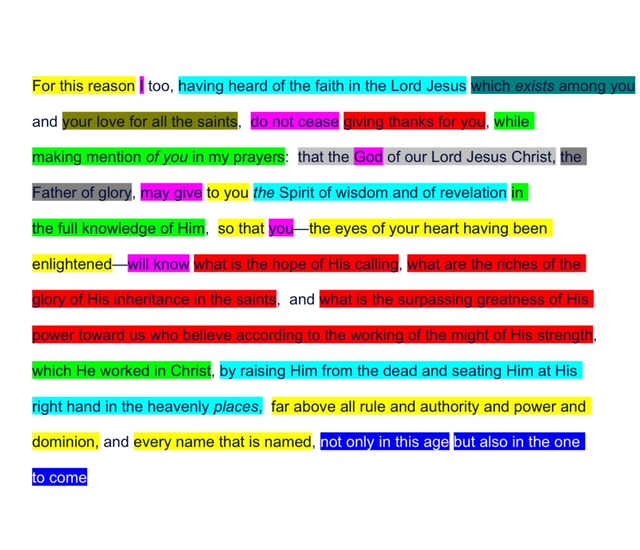
For this reason I too, having heard of the faith in the Lord Jesus which exists among you and your love for all the saints, do not cease giving thanks for you, while making mention of you in my prayers; that the God of our Lord Jesus Christ, the Father of glory, may give you a spirit of wisdom and of revelation in the knowledge of Him. I pray that the eyes of your heart may be enlightened, so that you will know what is the hope of His calling, what are the riches of the glory of His inheritance in the saints, and what is the boundless greatness of His power toward us who believe. These are in accordance with the working of the strength of His might which He brought about in Christ, when He raised Him from the dead and seated Him at His right hand in the heavenly places, far above all rule and authority and power and dominion, and every name that is named, not only in this age but also in the one to come. – Ephesians 1:15-21
No, I didn’t diagram it, but I broke it down by phrases and clauses:
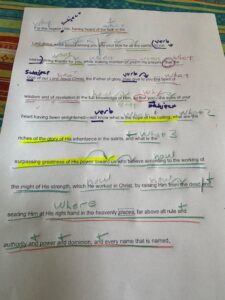
True confessions time: I didn’t diagram it, but I tasked Chat GPT with it. If it could have laughed, it would have. I’ll post its response in the Facebook post I do about this blog post.
At its core, what’s this 175 word sentence about?
To know, we need the subject and the verb: I do cease
I (Paul) do (not-adverb) cease.
What doesn’t Paul stop doing?
Giving thanks.
For whom?
For you (the Ephesian believers)
Why? About what is he giving thanks?
For this reason – Paul’s heard about their faith in Jesus and their love for the saints
When is he giving thanks?
While he’s praying
What is he praying?
That God (who? What God? of our Lord Jesus Christ, the Father of glory) may give . . .
What may He give?
His Spirit (What’s the nature of His Spirit? – of wisdom and revelation)
Wisdom and revelation about what?
in the full knowledge of Him
A quick aside:
What about that subjunctive – “may give?” Maybe He will, maybe He won’t? No, it’s a certainty – based on a condition. What’s the condition – their faith. Those who have faith in Jesus are given this Spirit. (See the beginning of the verse)
Why?
So that they, having been enlightened, will know
What?
- The hope of His calling
- The riches of the glory of His inheritance in the saints
- What is the surpassing greatness of His power
Wow.
What is this power?
- It’s toward us who believe
- It’s according to the working of His might and strength
Which He worked in Christ – we’ve seen it in action
- He raised Jesus from the dead
- He seated Him at His right hand
Where?
In the heavenly places: far above all rule and authority and power and dominion and every name that is named
When?
Not only in this age, but also in the one to come
Paul, I couldn’t have said it better myself. (Duh.)
I write because Yahweh is awesome, and I want everyone to know it.





One Comment
Melissa Todd
This is so fun!!